Animated Social Gadget - Blogger And Wordpress Tips

Tuesday, 24 March 2015

Matwiku horticulture farmers benefit from an exchange visit

By Joyce Okuta and Bob Aston
Exchange visits, which are also called study tours, have been used for a long time as a way of sharing knowledge between farmers. They have been proven to lead to mutual knowledge increase, due to practical demonstrations and they have also enabled farmers to become more aware of their own skills and capacities.
In order to increase access to knowledge and information amongst farmers in Matwiku area of Githiga Ward, Laikipia County, the Arid Lands Information Network (ALIN) organized for an exchange visit for three (3) members of Matwiku Horticulture Growers S.H.G on March 13, 2015 to travel to Ilchamus Ward of Marigat Sub County to witness the launch of Nolororo Horticulture Project, which was also an open day to showcase climate smart agriculture and offer farmers an opportunity to interact with county leaders.
ALIN in partnership with Act Change Transform (Act!), with financial support from Department for International Development (DFID) and Swedish International Development Cooperation (SIDA) is implementing a climate smart agriculture project in Baringo, Laikipia and Kajiado counties with the aim of strengthening communities’ resilience to impacts of climate change while conserving natural resources.
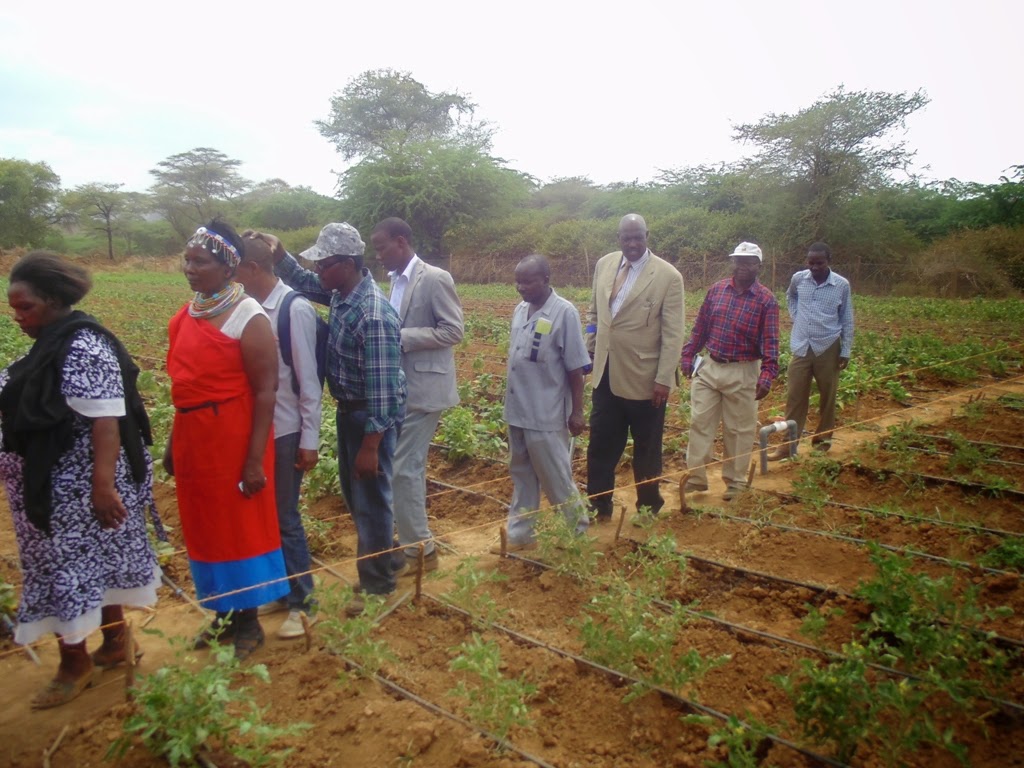
Farmers being shown around the Nolororo Horticulture Project
The project supported Nolororo women group to establish a drip irrigation system for horticultural production. The group members have been taught about plant protection, harvesting, value addition and marketing. They are now using drip irrigation technology to produce nutritious food.
The objectives of the exchange visit included; to expose the farmers from Matwiku Horticulture Growers Self help group to the activities done by Nolororo women group, to allow the farmers to exchange experiences and plan for the future use of the practices they observe and to assist farmers to gain confidence with what they are doing in the project so that they can explain and teach others.
Mr. Peter Gicheru, Secretary Matwiku Horticulture Growers self help group noted that the exchange visit had proved to be an enriching experience as he had managed to learn a lot from Nolororo women group.
“The opportunity that ALIN provided for us has enabled us to learn better farming methods and crops that we can cultivate in our own project. I realized that farmers in Ilchamus ward are lucky as the climatic condition is ideal for water melon and tomatoes and they take a shorter duration to mature unlike Matwiku,” said Mr. Gicheru.
Gicheru said that he is now planning to start farming in Ilchamus ward as cost of production is slightly lower there compared to Matwiku and the returns are also better. He added that horticultural crops can do well using drip irrigation and encouraged farmers to adopt the technology to increase their income.
Farmers being shown the project water source
The Nolororo women group activities focus on practicing Climate Smart Agriculture. This is agriculture aimed at reducing emissions at the farm level, conserving natural resources like soils and water while increasing nutritious food production at household level at the same time increasing family incomes.
On her part, Mrs. Lucy Mumbi a member of Matwiku Horticulture Growers self help group shared farming experiences with members of Nolororo women group. She noted that unlike Nolororo women group her group is composed of more men than women.
“Human-wildlife conflict is common in Matwiku area and we rely on men to offer security during such times. Nolororo women group is lucky since there is a steady supply of water from river molo,” said Mrs. Mumbi.
She thanked ALIN for the opportunity to visit the group and felt motivated to work hard and be more open minded when it comes to new technologies and farming methods.
ALIN has been involved in knowledge sharing for more than 22 years now, using various platforms that include the use of video documentations, exchange visits, open learning days and articles aimed at farmers and pastoralists. These experiences have helped farmers to access knowledge and information, which have helped to empower many farmers in arid areas.

Monday, 23 March 2015

Early detection, best for control of army worms

By Bett Kipsang’

Army worms are green-striped caterpillar larvae of the adult army worm moth; they are among the most destructive crop pests and a common pest of grass. Army worms will also eat corn, beets, beans, clover, flax, millet and other grains. Mature caterpillars can ruin an entire crop field in only a few days. The name “Army worm” is derived from its feeding habits; they travel in small armies, eating everything in their path.
At larvae stage, the moths feed very heavily and can wreak havoc on crops if left to multiply; they eat everything in an area until the food supply is exhausted, then the entire “army” moves to the next available food source.
Once its wings are fully dried and expanded, the adult butterfly or moth can fly in search of a mate. Mated females lay their fertilized eggs on appropriate host plants, beginning the life cycle anew.  
Noah Koinett inspecting an army worm trap
Some of the signs that of army worms infestation is an increase of the number of birds in your yard. Birds eat the caterpillars, but usually do not eat enough of them to keep the infestation under control. Brown spots on your lawn are often the first sign that army worm are about to strike.
Look for holes in the leaves or pieces missing off of leaf edges where the army worms have eaten them. Look under the plants for army worms or signs of their droppings. You may also find larvae under plant debris lying in the field. If you are growing barley or wheat, you may find worms inside of the heads.
Control measures.
Army worms are hard to detect as the caterpillars migrate at night in search of new feeding areas. The best way to control Army worms starts with understanding and looking for early signs of army worm damage. The earlier you treat the problem, the easier it is to control and the lesser the damage crops will sustain.
Cut the grasses short, then collect and burn or water it well to move the caterpillars out of the thatch. Spraying the grass heavily with a liquid insecticide kills the pest; make sure to follow the manufacturer’s directions. Leave the sprayed lawn alone for at least 3 days without mowing or watering to give the insecticide time to work.
The ministry of agriculture has developed a method of detecting the signs of Army worms in an area. A trap with pheromones substance is placed in an open field to attract female moths to the trap; the substance producing male like scent also has tranquilizing effects that makes the insect immobile. If a female moth is seen in the trap, it is a clear indication that army worms are visiting the area.
 ‘‘We check the trap every week, and we raise the alarm quickly in case we find the moths’’ said Noah Koinett, an agriculture extension officer in Rumuruti ward. Noah told the Ng’arua Maarifa centre that the government is always on high alerts for any sign of migratory pests.

ALIN launches Nolororo Horticulture project

By Joyce Okuta

The Arid Lands Information Network (ALIN) on March 13, 2015 launched Nolororo Horticulture project in Ilchamus ward in Marigat Sub County.  ALIN in partnership with Act Change Transform (Act!), with financial support from Department for International Development (DFID) and Swedish International Development Cooperation (SIDA) is implementing a climate smart agriculture project in Baringo County with the aim of strengthening communities’ resilience to impacts of climate change while conserving natural resources.
The launch was attended by Marigat Sub County Administrator, Ilchamus ward Member of County Assembly (MCA), Ilchamus ward administrator, Sub-county Agriculture Officer, Environment and Natural Resources officers, Agriculture Sector Development Support Program (ASDSP), ALIN project manager and Matwiku Horticulture Growers self help group.
Guests being shown the Nolororo horticulture farm

  
The project supported Nolororo women group to establish a drip irrigation system for horticultural production. The group members have been taught about plant protection, harvesting, value addition and marketing. They are now using drip irrigation technology to produce nutritious food.
Among the exhibitors included; Nolororo women group, Kerio valley development Authority (KVDA), Kapkuikui Self Help Group, Ministry of Agriculture, Livestock and Fisheries development, National Irrigation Board (NIB) and Ministry of Environment and Natural Resources.
Speaking while launching the project, Mr. William Chelal, Marigat Sub-county Administrator lauded the efforts made by ALIN and other organization in uplifting the livelihood of farmers. He said that the field day was a wakeup call for the people of Baringo County to work hard in order to be empowered.
“It is a high time for the farmers to adopt appropriate technologies to ensure sufficient food production. Farmers should join organized groups in order to tap the vast opportunities available in the county,” said Mr. Chelal.
Hon. Wesley Kakimon, Ilchamus ward MCA said that he is ready to support Climate Smart Agriculture Initiatives in the area, since the initial cost for installing the drip kit is affordable and the county can support such initiatives.
He added that the community should embrace such technologies to avert poverty. He encouraged members of Nolororo women group to train other groups about the technology.
Guests following proceedings during the launch of the project
Mr. Levis Saning’o, Ilchamus ward Administrator noted that the project has eased the work of Nolororo Women group as they are now able to get time to engage in other development activities in the community. He noted that previously the group used to spend close to 8 hours irrigating their farm and this used to be expensive as they had to hire labour.
On his part, Mr. Noah Lusaka, ALIN Project Manager thanked the county government for the cooperation given throughout the project implementation. He pointed out the dissemination done on Sauti ya Mwananchi radio and Standard Newspaper as an indication that the work done by Nolororo women group is known.
”The group has realized a drastic reduction in use of fuel for pumping water. This has reduced emissions and also reduced time spent irrigating the farm. This has also helped to mitigate the effects of climate change as well as increasing food production,” said Mr. Lusaka.
The objective of the event was to demonstrate to communities and stakeholders the various opportunities in food production using minimal water resources and appropriate technologies as an adaptation strategy to climate change.
The Nolororo women group activities focus on practicing Climate Smart Agriculture. This is agriculture aimed at reducing emissions at the farm level, conserving natural resources like soils and water while increasing nutritious food production at household level at the same time increasing family incomes.

Thursday, 19 March 2015

Empowering pastoralists through value addition of sheep and goat skins

By Bob Aston
Kenya experiences as high as 70 percent pre and post-slaughter losses in sheep and goat skins. In order to address low value addition of sheep and goats products and by products in Laikipia County, the sheep and goats value chain platform developed a concept note titled “Empowering pastoralist women and youths through value addition of sheep and goat skins in Laikipia County.”
The project which is being implemented by the Agriculture Sector Development Support Program (ASDSP), Laikipia County Government and Il Ng’wesi Conservancy and collaborators like Kenya Bureau of Standards (KEBS), Kenya Leather Development Council and Kenya Industrial Property Organization, is aimed at reducing pre and post-slaughter losses of sheep and goats skin from 70 percent to below 20 percent and also increase the cost of value added skins.
Picture of sheeps being exhibited
Some of the issues that the project aims to address include; high losses of skins due to poor pre and post-slaughter practices, low level of value addition for sheep and goat skins and few economic activities for women and youths in Laikipia North Sub County.
Enhancing viable and equitable commercialization of the sheep and goat value chain is expected to play a big role in empowering pastoralist women and youths in Laikipia North Sub County.
Reducing raw skin losses in the County through pre and post slaughter management is expected to increase the availability of skins in the market and also increase price of skins and leather. The skins will be value added through tanning and product development. This will result into improved economic status of women and youths.
Exposure visits have also been planned to Wiyumiririe and Alpharama tanneries and other exposure visits to Kariokor and Athi River Prison to learn about leather utilization. The groups will also be linked to cottage industries that use hair/wool to produce carpets and other products.
Training of trainer sessions will be conducted for the selected Group members on: pre and post-slaughter management of sheep and goat skins, tanning (organic and chemical) and leather product development.
A participatory approach will be used capacity build 120 pastoralist trainers on pre and post slaughter management of skins, group dynamics, product development market linkages and networking.
The project will also involve undertaking tree planting for environmental conservation by increasing tree cover thus reducing soil erosion and increasing water infiltration into the soil.
More than 600 people are expected to benefit directly from the project and be able to practice pre and post practicing recommended pre and post-slaughter management of skins and also be able to produce high level of value added products from leather.

Friday, 13 March 2015

Livestock stakeholders set to hold an agribusiness trade fairs in Nyahururu

By Bob Aston
The Kenya Livestock Producers Association in collaboration with the Laikipia County Government, co-hosts Eastern Africa Farmers Federation (EAFF), KCB Foundation, Agri Profocus, ACK Church, Isinya Feeds, Unga, FarmCare Ltd, Cooper K- Brands and Agricultural Industrial Network is set to hold the second agribusiness Trade fairs on March 27-28, 2015 at Nyahururu stadium, Nyahururu town, Laikipia County. The theme for the Agribusiness Trade Fair will be “Farming is big Business.”
The highlight of the trade fair will be road shows, demonstration plots, insurance services, agricultural products, agro chemicals and seeds, farm machinery and equipments, biogas and bio-fuels demonstration, financial services products, dairy products, edairy, rabbit, quails and bee keeping, artificial insemination (AI), greenhouse farming, new innovations, mcommerce, real estate and domestic tourism.
The objectives of the trade fair include; to afford the regions farmers, service providers and industry suppliers a unique opportunity to showcase their products for benchmarking and trade, expose agricultural sector stakeholders (practitioners and suppliers) to new technologies and ideas for better efficiencies and quality, provide a platform for short seminars and demonstrations to small scale and large scale players in the sector, to showcase outstanding breeds for different livestock and to encourage farmers to invest in farming as a business.
Governor Irungu being shown certified seeds during last years trade fairs
According to Patrick Kimani, Chief Executive Officer, Kenya Livestock Producers Association, the trade fairs/exhibition will serve as a unique platform for all stakeholders in all sectors of the economy to meet to experience their fulfillment in their business through education, exhibition and entertainment.
 It will be an opportunity where one will be able to cost effectively, joyously, conveniently and easily conduct some business on wide range of products and services as well as introduce and demonstrate the latest products, innovations, machinery and techniques that are available to the citizen in those areas.
“Kenya Livestock Producers Association will bring unique audiences of these major sectors in one place for two days. We therefore invite you to take this rare opportunity where serious farmers and your clients will come together for you to exhibit your products and services by taking exhibition space,” said Mr. Kimani.
The trade fairs are monthly events organized by the Kenya Livestock Producers Association in various counties in the Country. Farmers and farmer groups are not charged for exhibiting during the trade fairs while entrance is free for members of the public. The guest of honor is expected to be Hon Joshua Irungu, Laikipia County Governor.

Wednesday, 11 March 2015

Farmers in Sipili sensitized on post harvest maize management

By Bob Aston

Ninety three (93) farmers from Sipili area of Ol-Moran ward, Laikipia West were on March 10, 2015 sensitized on a maize concept note titled “Formation, Legalization and Training Maize Value Chain Groups on Post-harvest Management.” The event which took place at Sipili Catholic Church Hall was organized by the Agricultural Sector Development Support Program (ASDSP).
In attendance included; Ol-Moran Ward administrator, ASDSP, SNV- Netherlands Development Organization, Arid Lands Information Network (ALIN), Ol-Moran Ward Agriculture Officer, Laikipia Produce and Marketing Co-operative Society and Sipili Cereal Bank.
Leah addressing the farmers
Speaking during the meeting, Leah Njeri, SNV Senior Governance Advisor, Procurement Governance in HGSF noted that post-harvest maize management has been a major challenge in Laikipia County as farmers lose up to 30 percent of maize harvest due to pests, diseases and rotting. 
She said this usually leads to lower incomes among smallholder farmers and for many households such losses threaten food nutrition and income security. She said that the various stakeholders involved in the project are keen to ensure that post harvest losses are not only reduced but that farmers start to benefit from farming.
On her part, Peris Mutua, Value Chain Development officer with ASDSP noted that the maize value chain lacks adequate and effective co-ordination due to lack of organizations to champion the collective interests of the value chain players leading to ineffective post-harvest management strategies.
Charles Keru,Ol-Moran ward administrator addressing the farmers
She said that the maize concept note project seeks to improve Maize value chain organization and co-ordination and reduce post-harvest losses of maize in Laikipia County. She said that ASDSP is currently implementing three value chains in Laikipia County.
“The essence of the project is to train farmers in order to reduce post-harvest maize losses. Most farmers in Laikipia West usually grow maize but they always experience high post-harvest losses,” said Peris.
Mr. Joseph Mwati, Chairman Maize Value Chain Core Group (VCCG) in Laikipia County informed the farmers that they will be trained in post harvest maize management in value chain groups of 20 or more members. He said that the value chain groups will also be capacity built by among others; ASDSP, SNV, ALIN, Eastern Africa Grain Council (EAGC) and the Ministry of Agriculture, Livestock and Fisheries.
The farmers agreed to have six (6) maize value chain groups in Sipili cluster. The value chain groups will be Kaharati Upper, Kaharati Lower, Dimcom A, Dimcom B, Kiriko and Kabati. Twelve sensitization meetings are currently being carried out in the six wards in Laikipia West with each ward hosting two meetings.

Monday, 9 March 2015

Celebrating women achievements during International Women Day 2015


By Bob Aston
Kenya on Sunday joined the World in celebrating the International Women Day 2015 whose theme this year was “Make it happen”. The event which is celebrated annually on March 8 commemorated the 20th anniversary year of the Beijing Declaration and platform for Action, a historic roadmap signed by 189 governments 20 years ago that sets agenda for realizing women’s rights.
The Beijing Platform for Action focuses on 12 critical areas of concern and envisions a world where each woman and girl can exercise her choices, such as participating in politics, getting an education, having an income and living in societies free from violence and discrimination. It envisaged that women empowerment and their full participation on the basis of equality in all spheres of society including participation in the decision making process and access to power are fundamental for the achievement of equality, development and peace.
The day represented an opportunity to celebrate the achievements of women while at the same time recognizing the challenges that women face and focusing more attention on women’s rights and gender equality.
Women being trained on bead work
Significant progress towards gender equality and empowerment of women has been realized over the years in Kenya. Currently the government has put in place several initiatives and formulated policies to support women including the Women Enterprise Development Fund, the Uwezo Fund and the 30 percent allocation of all public procurement to women.
The Kenya constitution has also improved women’s rights particularly on citizenship, land and property rights, participation in the political process and on discrimination. The constitution has also ensured that a third of elected and appointed posts in public offices are reserved for women.
Another significant milestone has been on the education front. In this year’s Kenya Certificate of Primary Education (KCPE), the ratio between girls and boys was 437,288 (49.7) girls and 443,258 boys (50.3) while 23 out of the 47 counties had more girls than boys sitting for KCPE examination. Girl’s performance also improved in the Kenya Certificate of Secondary Education (KCSE) while the gender ratio was 54 percent boys and 46 percent girls.
The countless acts of courage carried out by women and their determination to make positive change has significantly contributed to the social and economic development of the country. However, disparity between women and men characterizes most spheres of society in the Country.
Women are still underrepresented in decision making positions. They also have less access to education, land and employment. Traditional ideas about the roles of girls and women particularly in rural areas has restricted their contributions. These ideas hold women back from contributing to important development goals, especially in areas of economic growth, nutrition and food security.
Giving women an equal opportunity and allowing them to reach their full potential would go a long way in not only uplifting their livelihood but also improving the economy of the country.